Outdoor Living · July 2026 · 8 min read
Porch Season: Making the Front Welcoming and the Back Cozy
Porches are the most underused rooms in Texas. Nearly every house I walk into has one, and nearly every one of them is holding a dried-out fern, a folded-up chair, and a doormat that's seen a decade. Which is a shame, because a porch is the easiest room in a house to make beautiful — and the one that changes daily life the most.
I think of them as two entirely different rooms with two entirely different jobs. The front porch is a greeting. The back porch or veranda is a retreat. Decorate them the same way and both fall a little flat.
The front porch: a welcome, not a display
Your front porch is the first sentence of your home. Before anyone sees your entry or your paint colors or the art you agonized over, they see this. And the goal isn't to impress — it's to make someone feel expected.
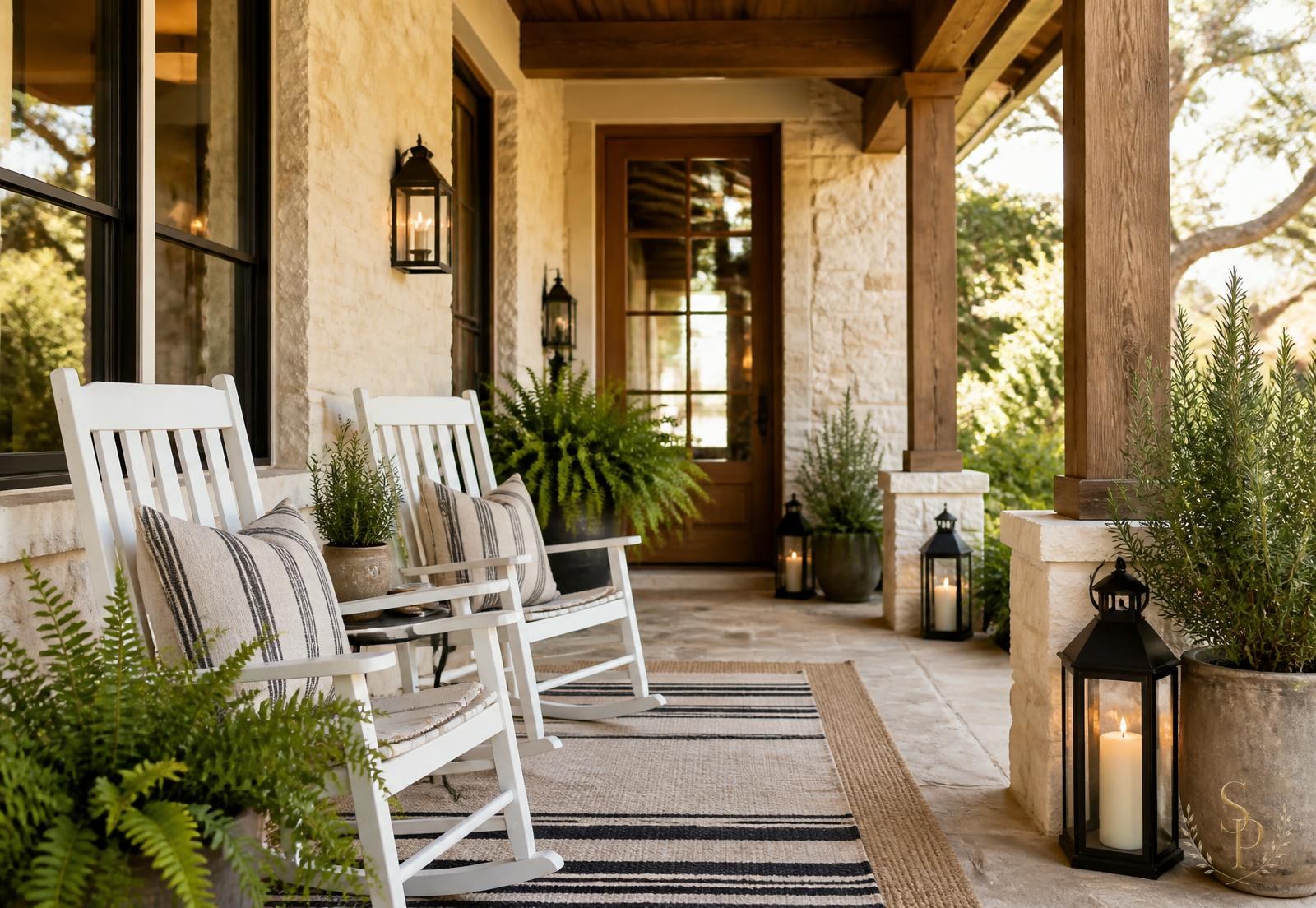
Three things get you most of the way there. Symmetry, because it reads as intentional even when it's simple: matched planters, matched lanterns, a pair of chairs. Scale, because almost every porch I fix has been furnished too small — a bigger planter, a wider door mat, a taller lantern. And light, because a warm bulb at the door in the evening says welcome more clearly than any wreath.
- A pair of substantial planters flanking the door — larger than your instinct, in aged terracotta, limestone, or dark glazed ceramic.
- Two chairs, even on a small porch. Two chairs say someone lives here and sits here.
- A layered mat: a large flatweave or jute rug with a smaller coir mat at the threshold.
- One real light source that flatters faces — warm 2700K, on a dimmer or timer.
- House numbers you can read from the street. Unglamorous and worth every penny.
Plants that actually live here
The honest truth about Texas porch plants is that most failures are exposure failures, not care failures. Ferns and hydrangeas die on a west-facing porch in July because that porch reaches 105 degrees by four o'clock. Match the plant to the light and the watering takes care of itself.
For shaded and covered porches — north-facing, deep overhangs, dappled oak light — Boston and Kimberly Queen ferns, hostas, caladiums, asparagus fern, ivy, and pothos in a protected spot all do beautifully. Kimberly Queen is my go-to over Boston fern here; it handles heat and drops far less mess.
For full sun and afternoon western exposure, choose the plants that thrive on neglect and heat: rosemary, lavender, Texas sage, lantana, vinca, purslane, agave, sedum, olive trees in pots, dwarf yaupon holly, and ornamental grasses like muhly. Herbs are a wonderful cheat — a big pot of rosemary and basil by the back door is beautiful, useful, and nearly indestructible.
- For fragrance near a seating area: rosemary, lavender, jasmine on a trellis, or a potted gardenia in shade.
- For height and structure: potted olive, dwarf yaupon, Italian cypress, or a standard-form ligustrum.
- For softness and movement: muhly grass, Mexican feather grass, asparagus fern.
- For color that lasts through August: lantana, vinca, purslane, and pentas — all heat-proven.
- Skip in a Texas July: hydrangea, impatiens, most annual pansies, and anything labeled part shade if your porch faces west.
One practical note: pot size is a survival strategy. Small pots cook and dry out by noon. Larger pots hold moisture, hold temperature, and look better. If a plant keeps dying in the same spot, put it in something twice the size before you blame yourself.
Textiles: where a porch stops feeling like a patio
Textiles are the difference between outdoor furniture and an outdoor room. Rugs give the space edges. Pillows and throws give it softness. Drapery or shade panels give it walls. All three can now be had in performance fabrics that live through sun and rain without going chalky.
- Rugs: a flatweave polypropylene or performance jute in a stripe or subtle texture. Size it so the front legs of all seating sit on it — undersized rugs are the most common outdoor mistake.
- Pillows: mix scale and texture, not just pattern — one stripe, one small-scale print, one solid textured, in a palette of two colors plus cream. Solution-dyed acrylic (Sunbrella and its cousins) is the material that lasts.
- Throws: a lightweight cotton or linen throw over an arm reads cozy even in July, and earns its keep on the cool mornings that follow.
- Cushions: deeper seats and thicker cushions change how long people stay. Comfort is a design decision.
- Shade and privacy: outdoor drapery panels, a bamboo shade, or a simple canvas curtain on a rod softens hard columns and drops the temperature noticeably.
- Skip: anything indoor-only. One Texas storm and a beautiful cotton pillow becomes a mildew problem.
The back porch: cozy, inviting, and yours
The front porch performs a little. The back porch or veranda doesn't have to perform at all — and that's what makes it precious. This is where I want a chair deep enough to curl into with a book, a table exactly the right height for a coffee cup, a lamp or a lantern for after dark, and enough softness that you'd choose it over the sofa inside.
Design it around one honest ritual. Morning coffee. An afternoon with a book. A glass of wine after the kids are down. Then make that ritual effortless: a side table within reach of the chair, a light you can turn on without getting up, a place to set the book down, a fan overhead, a citronella or a candle on the table. Almost nobody uses a back porch that requires a trip inside for the small things.
Then layer as if it were a living room. A rug. Two seats angled toward each other rather than both facing out. Something living. Something that smells good. Something on the wall — an outdoor mirror, a piece of iron, a hanging planter — so the space has a fourth surface and doesn't feel like it's floating.
Peace at home
Our homes are a reflection of us, and I am, more than anything, about creating peace at home. Your sanctuary — a place to rest, to feel safe, to feel at ease. A porch is often where that peace is easiest to find, because it's outside the to-do list. The laundry isn't visible from the swing. The email isn't loud over the cicadas.
So start there, if the rest of the house feels overwhelming. Two chairs, a rug, a large pot of rosemary, a warm light, and one soft thing. You'll use it within a week, and it will change how the whole house feels to come home to.
A well-loved porch is proof that a home is being lived in, not just looked at.