Seasonal Styling · August 2026 · 7 min read
Why I Order Fall in July: Planning Your Autumn Decorating Early
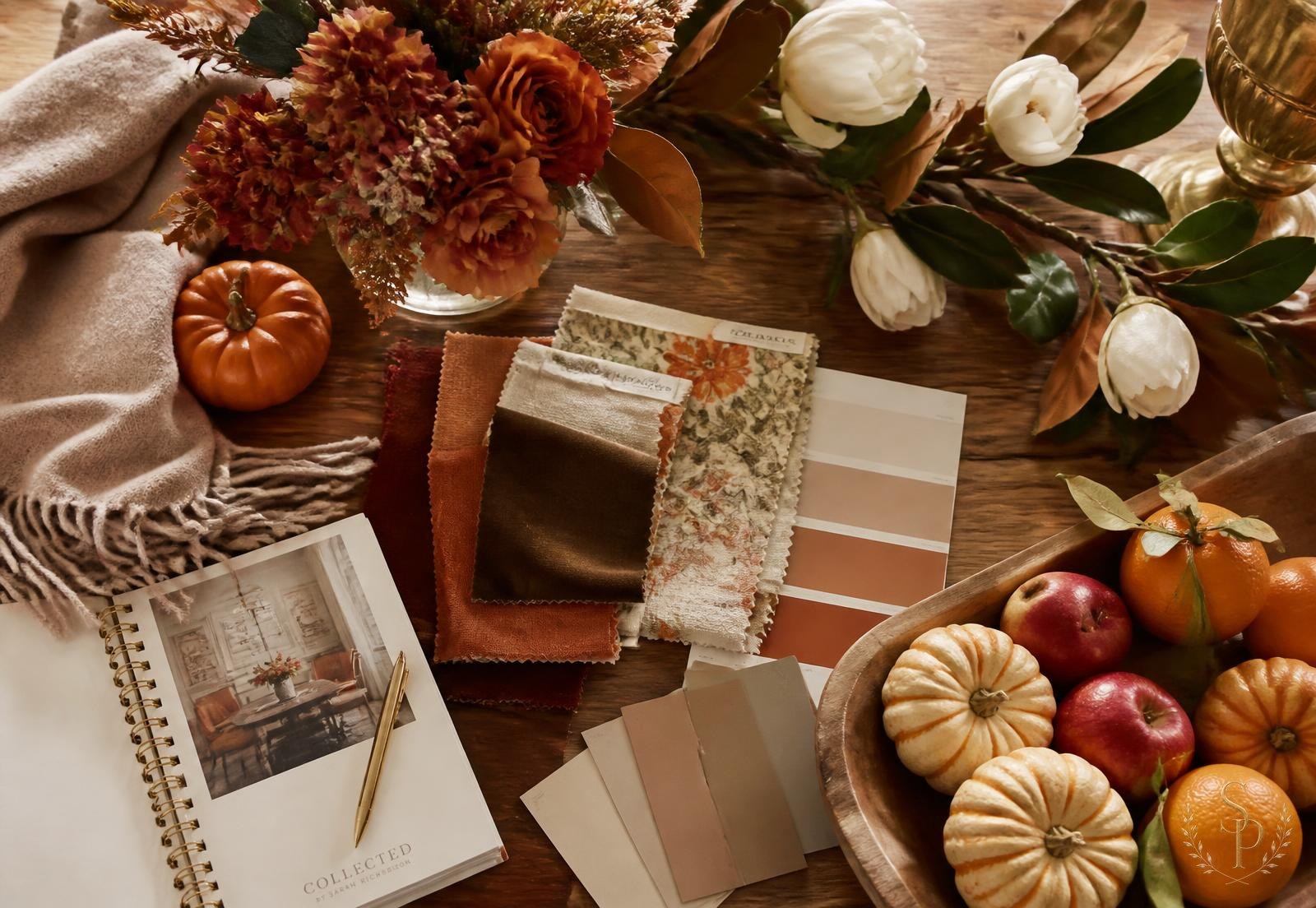
Every year, somewhere around the middle of July — when it is 102 degrees and nobody in Texas wants to hear the word autumn — I sit down at my table with fabric swatches, paint chips, and a notebook, and I plan fall. It looks a little ridiculous. It is also the single reason my clients' homes are finished and beautiful the first week of September instead of half-decorated in October.
Seasonal decorating is one of the few parts of design where the calendar, not the budget, is the real constraint. The best silk florals sell out. Garlands go on backorder. The pumpkin grower who can get you thirty heirloom pumpkins in the size and color you actually want needs to know in advance. So I order everything in July and August, and I plan the palette before I order a single stem.
Start with the palette, always
Before I buy anything, I build the design palette. Not a theme, not a Pinterest board of other people's porches — a palette, drawn from the home itself. I look at the entry, the wall color, the stone or brick, the front door, the wood tones inside, the rug that's already in the living room. Fall decor that fights the house it's sitting in never looks right, no matter how pretty the individual pieces are.
Then I decide where on the autumn spectrum we're living this year. There's the warm, traditional direction — pumpkin orange, apple red, gold, chocolate brown. There's the quieter, more neutral direction — cream, oatmeal, dried wheat, bronze, pale sage. There's the moody direction — plum, burgundy, deep rust, near-black greens. And there's the one I return to most in Hill Country homes: browns and creams as the foundation, with orange and a little red doing the singing.
Because honestly, there is just something about pumpkins, apples, oranges, and browns. It's the palette of harvest and of coming inside. Add a soft blanket over the arm of a chair for the first cool morning and the whole house exhales.
Tell your designer the look and feel you want
This is the part I want every client to hear. The more you tell me about the look and the feeling you want, the closer I can get to your vision — and the fewer surprises there are when the boxes arrive. Do you want it elegant and restrained, or abundant and layered? Do you want the porch to be the showpiece, or the mantel and the table? Is this a house that hosts Thanksgiving for eighteen people, or a quiet house for two?
Send me the photo you saved. Tell me the color you keep coming back to. Tell me you hate anything that looks like a craft store. Tell me your grandmother's ironstone platter has to be in it somewhere. All of that is useful. Vision is specific, and specifics are what let me bring it to life instead of guessing.
What I order in July and August
Once the palette is set, the ordering is straightforward — and early. My standing list:
- Silk and dried florals — the good ones, in the palette colors, ordered while the selection is still complete. Real-touch maple, oak, magnolia, hydrangea, berry stems, dried grasses and wheat.
- Garlands and wreaths — for the mantel, the stair rail, the front door, the kitchen window. Always order longer than you think you need; a thin garland is the giveaway.
- Textiles — pillow covers, a table runner, throws in velvet, wool, or brushed cotton. Fall is a texture season more than a color season.
- Candles, hurricanes, and brass or wood risers to give the arrangements height.
- Containers — footed urns, dough bowls, crocks, baskets. Containers are what make the difference between decor and a display.
- A few new permanent pieces if the room needs them, since anything upholstered or custom takes weeks and can't be decided in September.
Then I call the pumpkin man
The fresh elements need their own plan, because they're grown, not manufactured. In August I meet with my supplier for pumpkins, hay bales, and cornstalks and we go over quantities, varieties, sizes, and — most importantly — dates. I want the heirlooms: Cinderella, Jarrahdale, Fairytale, the pale Lumina whites, the warty greens. Uniform orange pumpkins from a bin are fine. Heirlooms in mixed sizes and shapes are what make a porch look designed.
We build the delivery around the decorating schedule, not the other way around. Fresh elements get placed last, right before they need to look their best, so nothing is soft or faded by the time company comes.
A decorating schedule that actually works
- July: build the design palette, walk the house, confirm the vision with the client, place florals and garland orders.
- Early August: order textiles, containers, candles, and any permanent pieces with a lead time.
- Mid-to-late August: meet the pumpkin and hay supplier, lock quantities and delivery dates, receive and inspect the shipments, and pre-build arrangements in the studio.
- Early September: install. Interiors first — mantel, entry, dining table, kitchen, guest room.
- Mid-September into October: fresh elements arrive. Pumpkins, hay, cornstalks, and mums go in, and the porch comes together.
- November: swap a few pieces toward Thanksgiving — more brown and gold, deeper florals, the table set — then quietly begin planning Christmas.
Working ahead like this buys something better than convenience. It buys calm. There's no scramble, no settling for the last available wreath, no October weekend lost to running around. The house simply turns the season on schedule.
The point of all of it
I don't decorate for fall because the calendar says to. I do it because the shift in a home is real — the first cool morning with coffee on the porch, the pot of soup, the blanket you actually reach for, everyone gathering a little closer inside. Our homes are a reflection of us, and marking the seasons is one of the warmest ways to say that a family lives here and pays attention.
Plan it in July and you get to enjoy it in September. That is the entire secret.
If you'd like your home styled for fall this year, now is exactly the right time to talk — before the good pieces are gone and the growers are booked.