Entertaining · July 2026 · 6 min read
The Fourth of July, and the Wonderful Feeling of Entertaining
There is a particular feeling to the hour before guests arrive on the Fourth of July. The ice is in the buckets, the candles are lit even though the sun hasn't gone down yet, and the whole house has that held-breath quality of being ready. I love that hour. After thirty years of designing rooms, I still think the truest test of a home isn't how it photographs — it's how it feels when it's full of people.
That's why entertaining and interior design have never felt like separate things to me. Design comes in all forms. Homes, yes, but also events, florals, tablescapes, invitations and graphics, the way a bar is arranged, the way a porch is lit at dusk. It's all the same instinct: shaping a space so the people inside it relax.
Start with the feeling, not the theme
Most Fourth of July decorating goes wrong in the same place — it starts with a theme instead of a feeling. Once red, white, and blue becomes the assignment, everything turns into plastic flags and paper banners, and the table ends up looking like a party-supply aisle rather than your home.
So I flip it. I ask what I want the evening to feel like. Usually the answer is easy and generous: cool drinks, warm light, everyone staying late. Then I decorate toward that feeling and let the patriotic palette come through in materials I already love.
A quieter red, white, and blue
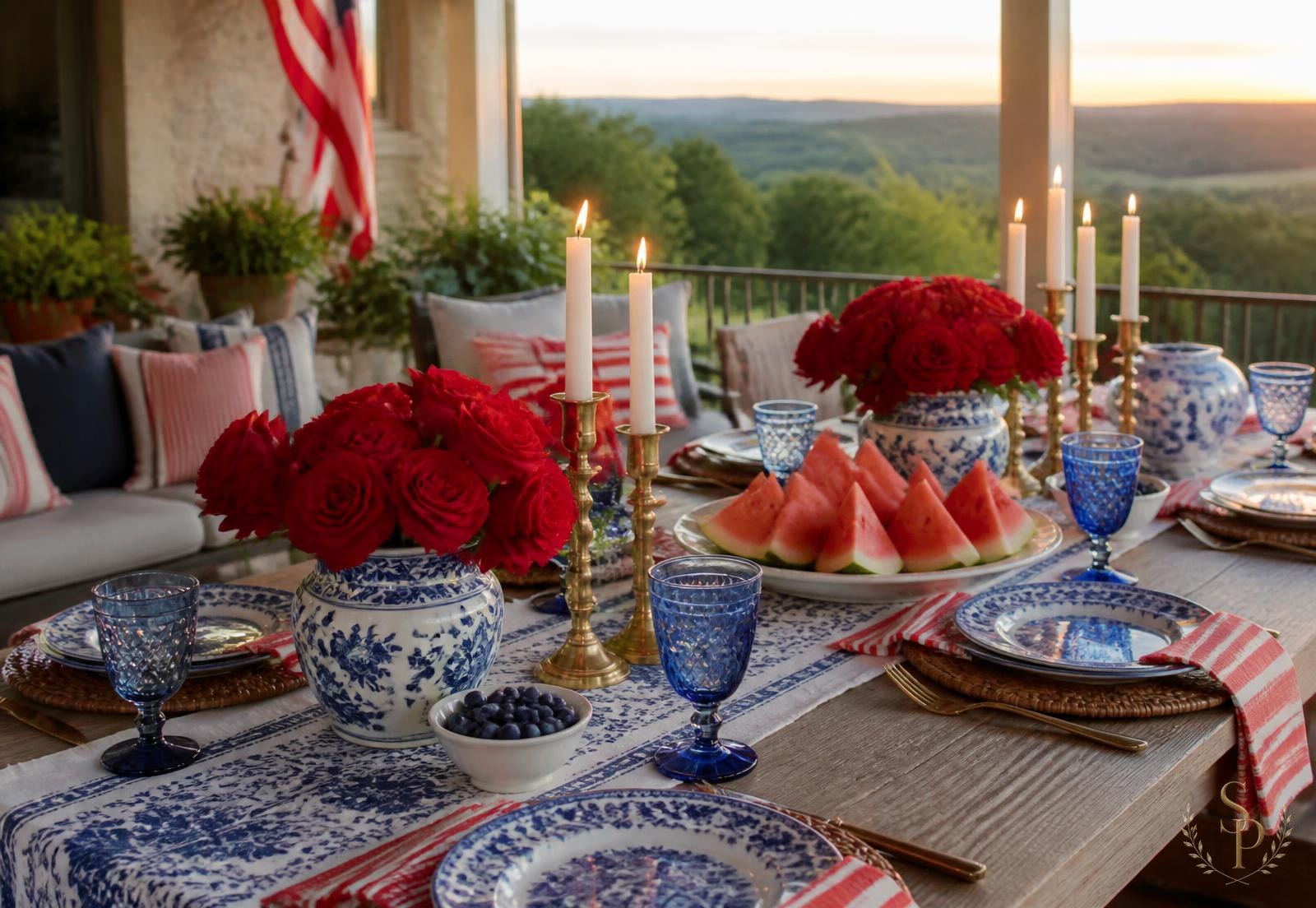
The palette is genuinely beautiful when you let real materials carry it. A few things I return to every summer:
- Blue and white porcelain — ginger jars, transferware, a stack of mismatched plates. It reads instantly patriotic without a single flag.
- Ticking stripe and grain-sack linens for runners and napkins, in navy or faded red. Texture does more than print.
- Real red flowers instead of decorations — garden roses, dahlias, zinnias, even a bucket of cut sunflowers with a few red stems tucked in.
- Brass and hurricane candles. Warm metal is the difference between a table and a tablescape.
- Watermelon, berries, and stone fruit as part of the centerpiece. Food is the best decor because it disappears as the night goes on.
- White as the resting place — white platters, white linen, white ironstone — so the reds and blues have room to breathe.
Design the flow, not just the table
The single most overlooked part of entertaining is circulation. Where do people set down a drink? Where does the line form? Where do the two people who always end up in a long conversation actually sit? I plan a gathering the way I plan a room: with zones. Drinks away from the food so the two crowds don't collide. Seating in small clusters instead of one long formal arrangement. Something to eat within reach of every chair.
In Texas in July, the flow question is also a heat question. Move everything you can to shade and to the hours after five. Ceiling fans on the porch, a cooler of cold towels, pitchers of something iced that doesn't require a bartender. Guests should never have to ask for anything.
Light is the whole party
If you do only one thing, do the light. Turn off the overheads. Put candles down the middle of the table — more than feels reasonable, in mixed heights — and add lanterns on the steps and low light at the edges of the yard. When the sun drops and the candles take over, the mood shifts audibly. People lower their voices and stop checking their phones. No arrangement of furniture has ever done that as efficiently as a dozen flames.
Design in all forms
I've styled homes and I've styled events, and the crossover is constant. The florals I arrange for a July table teach me something about the scale of an arrangement in a client's entry. A menu card I lay out for a party informs how I think about the graphics in a mood board. A wedding taught me more about lighting layers than any showroom ever did.
It all comes back to the same idea: our homes are a reflection of us, and the way we welcome people is part of that reflection. You don't need a perfect house to host well. You need a little intention, good light, and the willingness to let people stay too long.
The best-designed evening is the one where nobody notices the design — they only notice they didn't want to leave.
If your gathering spaces aren't quite working — the table that's too small, the porch nobody uses, the room that never feels ready for company — that's exactly the kind of problem I love to solve. Sometimes it's furniture. Sometimes it's just lighting and a rug. Either way, it's design.