Living Well · August 2026 · 7 min read
Creating Peace at Home: Designing a Sanctuary You Can Rest In
By August in Texas, we've all stopped pretending we're going outside before seven in the evening. The days get quiet and interior in a way they don't the rest of the year — and that makes late summer the best time I know to think honestly about whether your home actually rests you.
Because that's the whole thing, for me. Beautiful is the easy part. What I really want for every client is peace at home: a house that lowers your shoulders when you walk in. Your sanctuary — somewhere to rest, to feel safe, and to feel at peace.
Calm is a design decision, not a personality trait
People often tell me they're just not calm people, as though serenity at home were a temperament. It isn't. Most of the anxiety a room produces is structural: too much visual noise, harsh light, nowhere to put things down, furniture arranged so no one can move through comfortably. Fix those and the room does the work for you.
- Reduce the number of things competing for your eye — fewer, larger, better pieces instead of many small ones.
- Give every daily object a home. Clutter is almost always a storage failure, not a discipline failure.
- Choose a narrow palette and repeat it. Repetition reads as restful; variety reads as busy.
- Round off the traffic paths. If you turn sideways to get through a room, the room is stressing you daily.
- Add texture instead of color when a space feels flat — linen, plaster, oak, wool, stone. Depth without noise.
Light first, always
Nothing changes how a home feels faster than its light. One overhead fixture blasting a room at full brightness is the enemy of rest. I want three or four sources in every room at different heights — a lamp on a table, a lamp across the room, something overhead on a dimmer, maybe a picture light or a candle. Warm bulbs, 2700K, everywhere you relax.
And put things on dimmers. It is the least glamorous, highest-return item on any of my project lists. Being able to take a room to a third of its brightness at nine at night is a genuine improvement to your evenings.
The bedroom is the sanctuary inside the sanctuary
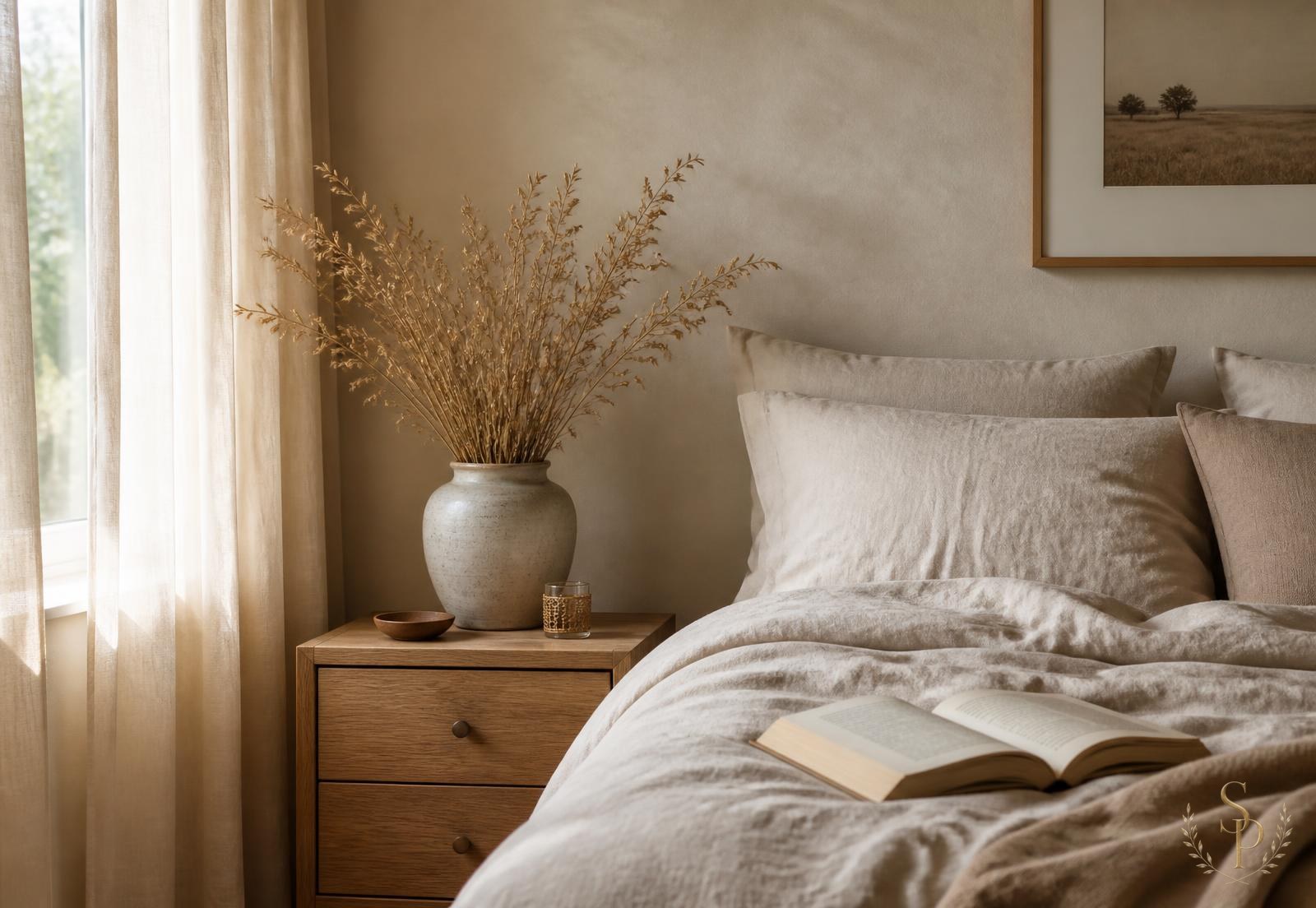
If the budget only stretches to one room, I almost always argue for the primary bedroom — and clients almost always want to spend it on the living room, where guests will see it. I understand the impulse. But you begin and end every single day in your bedroom, and the state of that room quietly sets the tone for both.
- Layered linen or cotton bedding you actually like touching, in tones close to the walls.
- Lamps or sconces on both sides — light you can reach without standing up.
- Real window treatments: something soft to filter, something opaque to sleep behind.
- A rug large enough that your feet land on it, not on cold tile.
- Nothing that belongs to work. No desk, no laundry pile, no charging station on the nightstand if you can help it.
- One thing that's only there because it's beautiful — a piece of art, a vase, an old book.
Design for the rituals you already have
The homes that feel most peaceful aren't the most styled — they're the ones designed around what actually happens in them. Coffee at the same window every morning. A bath on Sunday nights. Reading in the same chair. Dinner at a table that isn't covered in mail.
So I ask clients to tell me their rituals, and then I make each one easier. A table beside the reading chair and a lamp behind it. A tray by the door so keys have a place. A drawer for the chargers. A candle where you'll light it. It sounds small. It's the whole difference between a house that looks calm and a house that feels calm.
Let it be a reflection of you
Peace at home is not minimalism, and it isn't a color palette. I've designed deeply layered, pattern-rich rooms that feel like the most restful places on earth, because everything in them belonged to the people who lived there. Your travels, your grandmother's chair, your children's faces, the books you actually read — a home full of your own story is inherently reassuring in a way that a catalog page never is.
A sanctuary isn't a style. It's a house that agrees with the person living in it.
If your home isn't giving that back to you yet, it's usually a handful of fixable things — light, layout, storage, and softness. That's the work I love most, and it's where every project I take on begins.